Category
InsightsDate
May 8, 2026

Modern engines rely on precise pressure readings to deliver performance, efficiency, and emissions control in equal measure. MAP, boost, and exhaust pressure sensors sit at the centre of that process, constantly feeding data back to the ECU to keep everything in balance. When they’re working properly, you don’t notice them. When they’re not, it shows quickly. This article breaks down what each one does, how they differ, and why they matter.
By ELTA Automotive
We all know how much more modern engines must balance in order to meet emissions standards while maintaining performance. Engine management now goes far beyond simple mechanical adjustment - a world away from the carburettor. Today, a network of sensors monitors every pulse, rotation and fluctuation.
Often overlooked, yet among the most important of these, are the pressure sensors monitoring air entering the engine, boost pressure from the turbocharger, and exhaust pressure leaving the engine.
Individually, these sensors may seem simple. But together, they allow the engine management system to understand how efficiently the engine is breathing, how the turbocharger is performing, and how emissions systems such as the DPF and EGR are operating.
These sensors primarily operate based on the piezoresistive effect; a scientific principle where electrical resistance changes in response to physical stress. At the heart of each sensor is a microscopic silicon diaphragm that flexes under pressure. This movement is converted into a voltage signal, which the engine control unit (ECU) uses to interpret real-time operating conditions.
Understanding how these sensors work together is essential for accurate diagnostics and avoiding unnecessary parts replacement. And that’s exactly what the independent aftermarket does best: diagnosing, repairing and keeping vehicles running efficiently long after they leave the dealer network.
Championing the Aftermarket means more than supplying parts. The ELTA VXPRO range meets the demands of the UK vehicle parc with components engineered to perform under serious pressure. A five-year warranty reflects complete confidence in the product quality and durability.
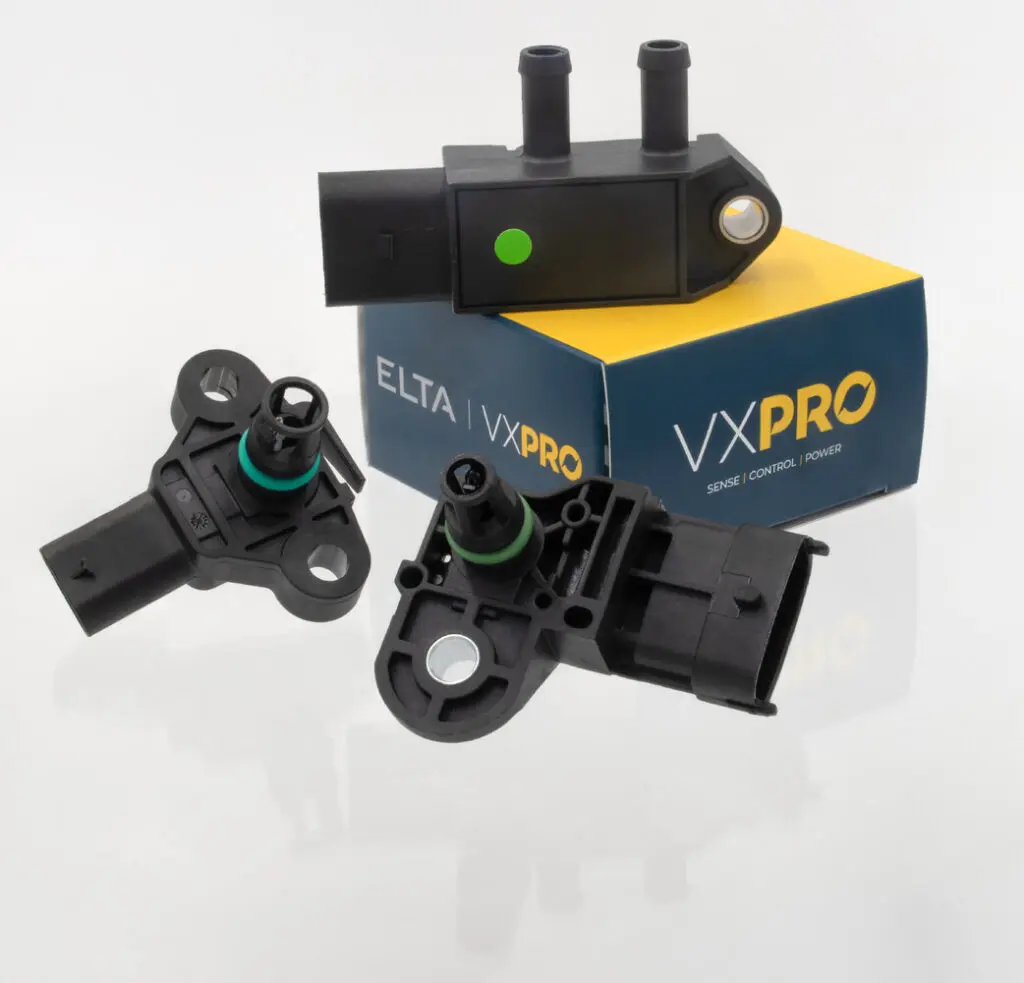
MAP Sensor
This sensor plays a key role in fuel injection control, ignition timing on petrol engines, EGR operation and turbocharger management. In many modern applications, the MAP sensor may also serve as the boost pressure sensor depending on its location within the intake system, meaning one sensor can provide multiple critical data points to the ECU.
Additionally, it is increasingly common for MAP sensors to incorporate an integrated air temperature sensor, allowing the ECU to calculate air density more accurately and further refine fuelling and combustion control.
When the MAP sensor fails or provides incorrect readings, the engine may suffer from poor fuel economy, reduced performance, excessive smoke on diesel engines or engine management warning lights.
Given its critical role in calculating engine load, accuracy and response time are essential — even small deviations in signal can have a noticeable impact on performance and emissions.
Boost Pressure Sensor
If the boost pressure sensor fails or reads incorrectly, the ECU may reduce turbo performance to protect the engine, often resulting in limp mode, poor acceleration or over-boost and under-boost fault codes.
As with MAP sensors, boost pressure measurement may be handled by a shared sensor depending on system design, and in some cases may also include integrated temperature sensing for improved accuracy.
Operating in high-temperature, high-vibration environments, these sensors must deliver consistent and reliable readings under demanding conditions, making build quality and durability key considerations.
Exhaust Pressure Sensor
Given the sheer volume of brands feeding into catalogue platforms, most factors and distributors refine A faulty exhaust pressure sensor can lead to incorrect DPF regeneration, frequent regeneration cycles, poor fuel economy, reduced performance and DPF warning lights.
With exposure to extreme temperatures and exhaust contaminants, robust construction and resistance to blockage or signal drift are essential to ensure long-term reliability.

Diagnostic Insight
Before replacing any pressure sensor, it is good practice to carry out a smoke test of the intake or exhaust system. This is highly effective in identifying leaks in pipework, intercoolers, hoses or connections that may be the root cause of incorrect pressure readings.
Misdiagnosis can lead to unnecessary sensor replacement when the underlying issue lies elsewhere in the system and this is something experienced technicians will always look to rule out first.
Championing Quality
While often overlooked, pressure sensors are precision components operating in some of the harshest environments on the vehicle. Accurate calibration, fast response times, and resistance to heat, vibration and contamination all play a role in ensuring consistent performance.
For the aftermarket, this means quality matters. Sensors that are engineered to OE standards (and built to perform under pressure) help ensure reliable diagnostics, consistent engine performance and long-term durability. This is where ranges such as VXPRO are designed to meet the demands of modern engine systems, delivering the consistency technicians rely on.
Conclusion
Understanding how these sensors interact helps technicians diagnose faults more accurately, avoid unnecessary parts replacement and identify underlying issues with turbochargers, intake systems and emissions components.
And that’s exactly what Championing the Aftermarket is all about — giving independent garages and motor factors the knowledge, support and quality components they need to compete, diagnose confidently and keep vehicles on the road. Learn more about Champion the Aftermarket here.
Because the aftermarket doesn’t just fit parts. The aftermarket keeps the world moving, with components built to perform under pressure.This is not a box-ticking exercise. It is a long-term commitment to data discipline.
For media inquiries, please contact:
Tim Brotherton
Marketing & Communications Manager at ELTA Automotive Ltd