Exhaust Gas Pressure Sensors

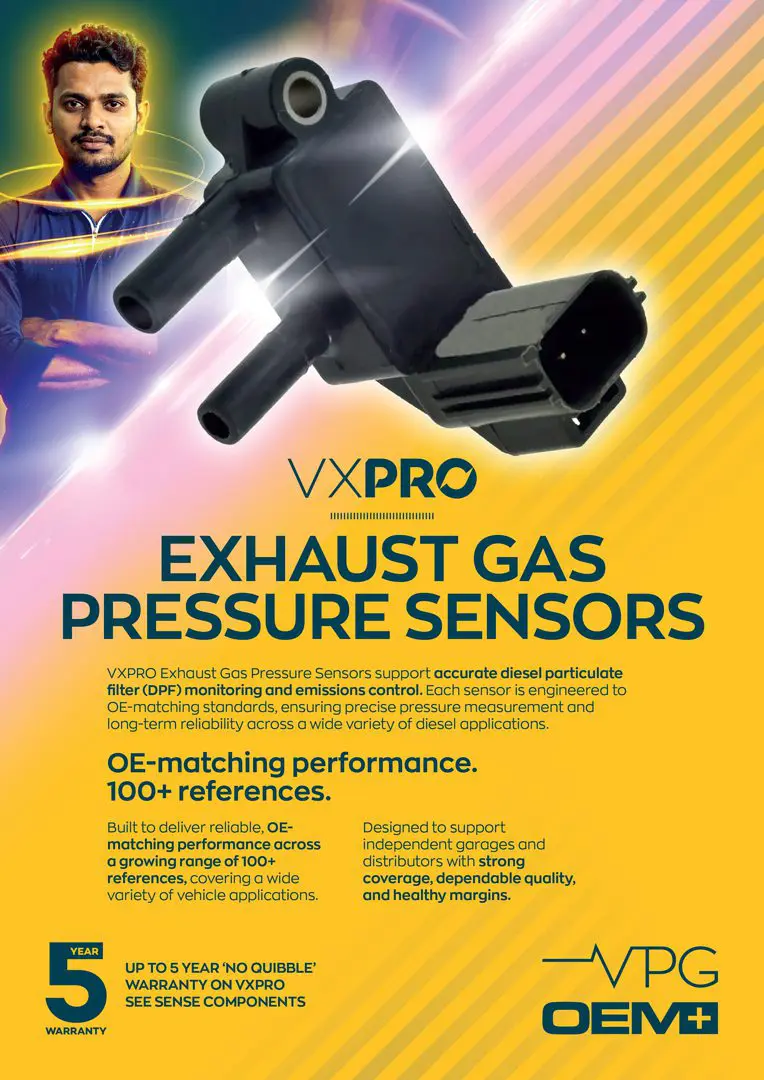
Our VXPRO Exhaust Gas Pressure Sensor range includes OE-matching references covering a wide range of modern diesel vehicle applications. These sensors provide the engine control unit (ECU) with accurate exhaust pressure data, enabling effective monitoring of diesel particulate filter (DPF) performance and supporting emissions control strategies.
Accurate exhaust pressure measurement is essential for DPF regeneration management, engine efficiency and compliance with increasingly stringent emissions regulations. Reliable sensor performance helps ensure optimal engine operation while reducing the risk of emissions-related faults and warning lights.
Operating in extremely demanding environments exposed to high temperatures, pressure fluctuations and contamination from exhaust gases, exhaust gas pressure sensors must deliver precise and consistent readings throughout their service life.
VXPRO Exhaust Gas Pressure Sensors are engineered to OE performance standards, providing dependable operation, accurate diagnostics and long-term durability across a broad range of diesel applications.
It's all part of our commitment to Champion the Aftermarket — providing independents with the quality parts, technical expertise and support they need to succeed.
VXPRO Exhaust Gas Pressur Sensors are supported by ELTA’s five-year trade warranty, available to authorised distributors and subject to our B2B warranty terms. TechASSIST and StockASSIST provide additional technical and stock support.

EGP sensors are critical service items on modern diesel vehicles and common causes of DPF-related comebacks. With StockASSIST, we help stockists identify the highest-demand references using UK-specific car parc and usage trends.
Here are 10 of the most requested EGP sensor references in our UK range:


EE2837
VXPRO Exhaust Gas Pressure Sensor
EE2837
1681883, 1684593, 1698614, 1775946, 1786775, AG915H209BA, AG915H209BAA, AV615H209EA, AV615L200AA, AV615L200AB, C2D21764, C2Z13154, CX235L200AA, CZQ7A11B03A, LR023131, LR028861, LR030030, LR052422, LR070166, LR071398, LR072661, 31319635, 31338869
Ford C-MAX, Focus, Galaxy, Kuga, Mondeo, S-MAX
Land Rover Defender, Discovery, Freelander, Range Rover
Volvo C30, S40, S60, S80, V40, V50, V60, V70

EE2715
VXPRO Exhaust Gas Pressure Sensor
EE2715
5146187AD, 5149278AB, 56044587AA, 56044587AB, 68078181AA, 5149235AB, 5149277AB, K05149235AB, K05149277AB, K05149278AB, K56044587AB, K68078181AA, 0051537728, 0061534928, 0061539528, 0071536128, 6429050100, A0051537728, A0061534928, A0061539528, A0071536128, A6429050100, 0041539528, 0051537428, A0041539528, A0051537428
Chrysler 300, Voyager
Dodge Nitro
Jeep Cherokee, Commander, Compass, Patriot, Wrangler
Mercedes-Benz A-Class, B-Class, C-Class, CLC-Class, CLK-Class, CLS-Class, E-Class, G-Class, GL-Class, M-Class, R-Class, S-Class, SLC, SLK-Class, Sprinter, Viano, Vito
Smart Forfour, Fortwo

EE2723
VXPRO Exhaust Gas Pressure Sensor
EE2723
51792301, 55204352, 55566186, 0862040, 862040
Alfa Romeo 147, 159, MiTo
Chevrolet Aveo
Fiat 500, Fiorino, Grande Punto, Panda, Punto, Qubo
Opel Astra, Combo, Corsa, GTC, Insignia, Meriva, Mokka, Zafira, Zafira Tourer
Vauxhall Astra, Combo, Corsa, GTC, Insignia, Meriva, Mokka, Zafira, Zafira Tourer
EE2931
VXPRO Exhaust Gas Pressure Sensor
EE2931
1876829, 1879205, 1882895, 1882896, BK2A9G824AA, FN155H295AA, FV415H295AB, FV415H295BB
Ford C-MAX, EcoSport, Focus, Kuga, Tourneo Connect, Tourneo Courier, Tourneo Custom, Transit, Transit Connect, Transit Courier, Transit Custom

EE2901
VXPRO Exhaust Gas Pressure Sensor
EE2901
227701177R, 6269052200, A6269052200, 208156551R, 208158341R, 228156551R
Dacia Duster, Logan, Sandero
Mercedes-Benz A-Class, B-Class, C-Class, Citan, Vito
Nissan Qashqai, X-Trail
Renault Captur, Clio, Fluence, Kadjar, Kangoo, Koleos, Megane, Scenic, Trafic

EE2836
VXPRO Exhaust Gas Pressure Sensor
EE2836
1315622, 1315684, 1366758, 1381208, 13822684, 1415606, 1416652, 1436292, 1496208, 3M5A5H209BF, 3M5A5L200AA, 3M5A5L200AB, 3M5A5L209AH, 6S715H209AC, C2C39730, C2Z11185, C2Z4252, LR007083, LR008463, Y40120360, Y64218215B, Y65018215, Y65018215A, 30677944, 30684336, 30731397, 30750460, 30757183, 30757189, 31293629, 31319368, 8699530
Ford C-MAX, Focus, Galaxy, Kuga, Mondeo, S-MAX
Jaguar S-Type, XF, XJ Series
Land Rover Freelander
Mazda 3
Volvo C30, C70, S40, S60, S80, V50, V70, XC70, XC90

EE2890
VXPRO Exhaust Gas Pressure Sensor
EE2890
223651719R, 8200641554, 8200811025, 8200974421, 8201000764, 6000616754, 93198718, 95519177, 95508630, 2236500QAK, 2276000Q0A, 2276000Q0B, 2373100Q0J, 04400815, 04420906, 04423771, 04451570, 093198718, 095508630, 095519177, 4423771, 4451570, 4400815, 8200443534, 8200443536, H8200443536
Dacia Duster
Fiat Talento
Infiniti QX
Nissan Juke, Navara, Note, NV200, NV300, NV400, Primastar, Qashqai, X-Trail
Opel Movano, Vivaro
Renault Captur, Clio, Espace, Fluence, Kadjar, Kangoo, Koleos, Laguna, Master, Megane, Scenic, Trafic
Vauxhall Movano, Vivaro

EE2714
VXPRO Exhaust Gas Pressure Sensor
EE2714
03G906051G, 059906051C, 076906051B, 7602
Audi A1, A3, A4, A5, A6, Q3, Q5, TT
Seat Alhambra, Altea, Exeo, Ibiza, Leon, Toledo
Skoda Fabia, Octavia, Rapid, Roomster, Superb, Yeti
Volkswagen Amarok, Beetle, Caddy, Caravelle, CC, Crafter, Eos, Golf, Jetta, Passat, Polo, Scirocco, Sharan, Tiguan, Touran, Transporter

EE2719
VXPRO Exhaust Gas Pressure Sensor
EE2719
55209194, 55219295, S8100181, 223650001R, 8200168253, 93857938
Alfa Romeo Giulietta
Fiat 500, Panda, Punto, Punto Evo
Nissan Interstar, Micra, Primastar, Qashqai, Tiida
Renault Clio, Espace, Fluence, Kangoo, Laguna, Master, Megane, Modus, Scenic, Trafic, Vel Satis

EE2838
VXPRO Exhaust Gas Pressure Sensor
EE2838
1606610880, 6G9N5L200AB, 1545549, 1546997, 1573374, 1693102, 1722675, 1722679, 1600077, 1674896, 1725470, 8V215H209CD, AB395L224AA, AV215H209AB, Y64518215A, Y64518215B, Y66018215A, 3078546, 30785486, 30785486AA
Citroën Relay
Ford Fiesta, Ranger, Tourneo Connect, Transit, Transit Connect
Mazda 2
Peugeot Boxer
Volvo C30, C70, S40, S60, S80, V50, V60, V70, XC60, XC70
Exhaust Gas Pressure Sensors are a critical component within modern diesel emissions systems. They monitor exhaust pressure before and after key emissions control components, providing the engine control unit (ECU) with the data required to manage diesel particulate filter (DPF) operation, exhaust gas recirculation (EGR) strategies and overall emissions performance.
By measuring pressure differentials across the DPF, the sensor allows the ECU to calculate soot loading accurately and determine when regeneration is required. This helps prevent filter blockage, maintain engine efficiency and ensure compliance with stringent emissions regulations.
Exhaust gas pressure data is also used to support turbocharger control and emissions management systems, making sensor accuracy essential for reliable vehicle operation. Without dependable pressure readings, the ECU cannot effectively manage regeneration cycles or optimise engine performance.
Operating in harsh exhaust environments exposed to extreme temperatures, vibration and contamination, exhaust gas pressure sensors must deliver precise and consistent measurements throughout their service life.
A faulty sensor can result in warning lights, reduced performance, failed regeneration events, limp-home mode activation and ultimately costly DPF or emissions system repairs. VXPRO Exhaust Gas Pressure Sensors are engineered to OE performance standards, delivering reliable operation, accurate diagnostics and long-term durability across a wide range of diesel applications.

Exhaust Gas Pressure Sensors operate in extremely demanding conditions and are continuously exposed to high temperatures, pressure fluctuations and exhaust contaminants. Common causes of failure include:
Because exhaust gas pressure sensor faults often present similar symptoms to blocked DPFs, damaged pressure pipes or EGR-related issues, accurate diagnosis should always include inspection of the complete emissions system.
When an Exhaust Gas Pressure Sensor fails or provides inaccurate readings, a range of drivability and emissions-related issues may occur, including:
Because many of these symptoms can also be caused by blocked DPFs, damaged pressure pipes or EGR system faults, accurate diagnosis should always include inspection of the complete emissions system alongside sensor testing.
Not sure whether the fault lies with the sensor, pressure pipes or the DPF itself? Our TechASSIST team can help guide you through diagnosis, live data analysis and best-practice installation procedures.
Camshaft Position Sensors
Provide precise camshaft data for accurate timing and smooth engine performance with VXPRO

Manifold Absolute Pressure (MAP) Sensors
Measure intake manifold pressure for accurate fuel and ignition control with VXPRO

Mass Airflow Sensors (MAFS)
Measure incoming air volume for precise fuel delivery and optimal combustion with VXPRO

 For Technical Support – Start a WhatsApp Chat with our TechASSIST Experts